
Today’s discussion will be that there is a relationship between the online persona that I have constructed as an educator and the many ways in which we can form and maintain relationships and networks online. You may be wondering; how do online identities relate to education now and in the future for our children? From experience, online education in school was once all about concealing the true identity and to some extent it still is for the purpose of privacy and security. Moreover, Gauntlett observes that ‘…some teachers are beginning to reject the ‘sit back and be told’ school culture…instead are setting their students challenges which are much more about making and doing’ (p.201, 2011).
As shown below, the personal account is set to private and I only accept follow requests from friends and family. I have accounts for my music and performing that were set up late last year; for this I have a public Facebook page and a public Instagram profile. Finally, I have the persona that you see; a future educator where I have public Twitter and Instagram profiles and this blog!
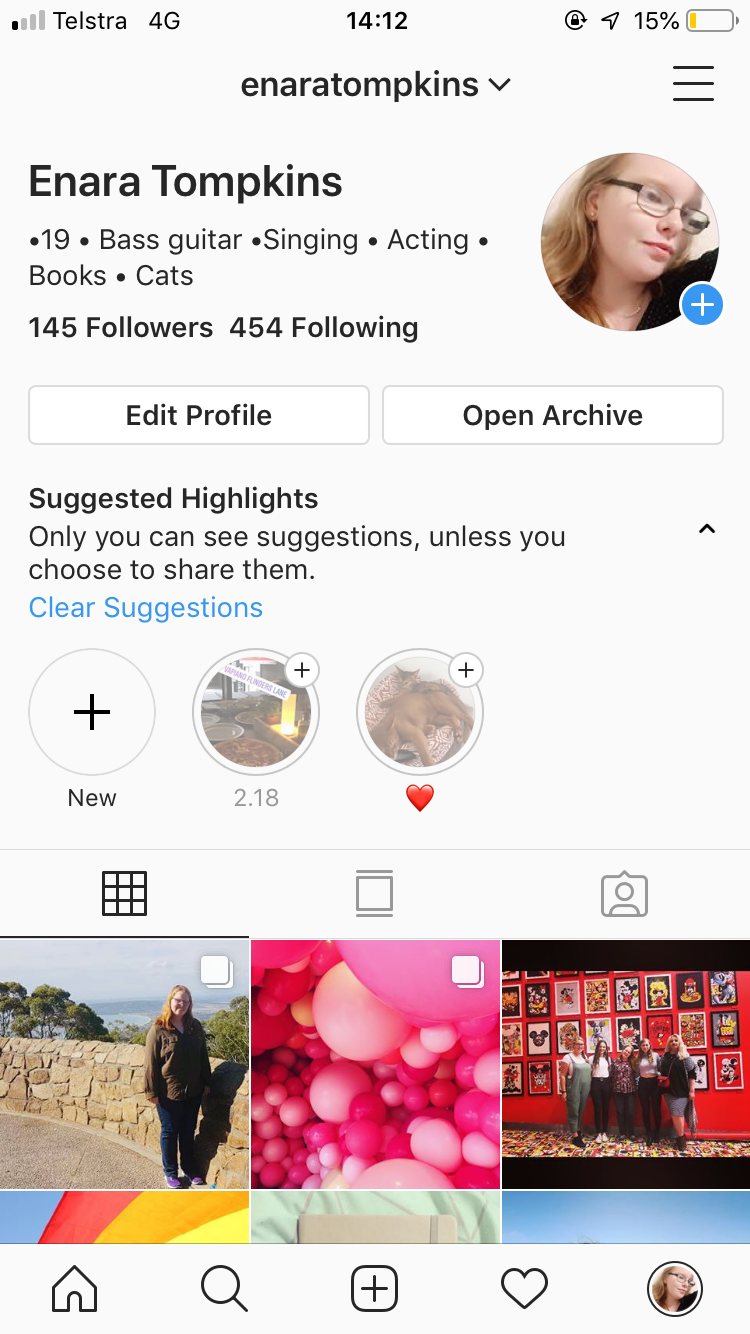
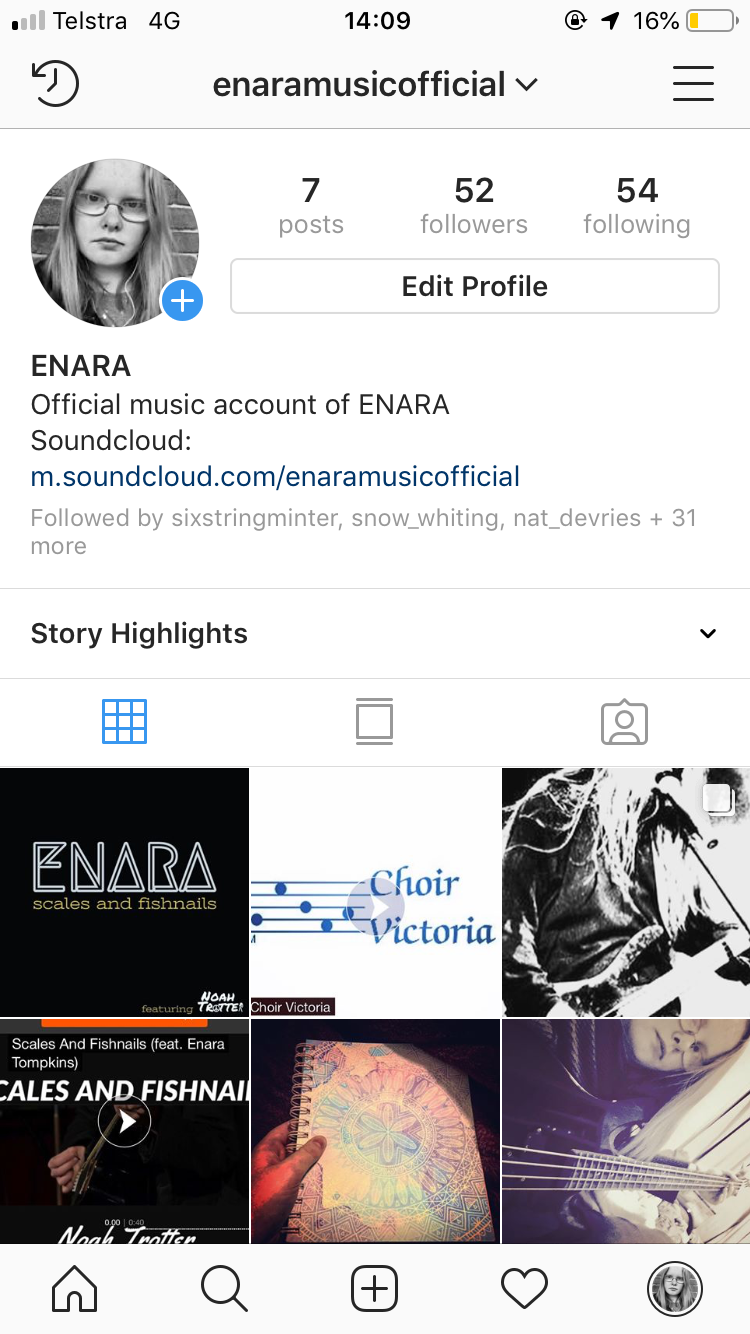
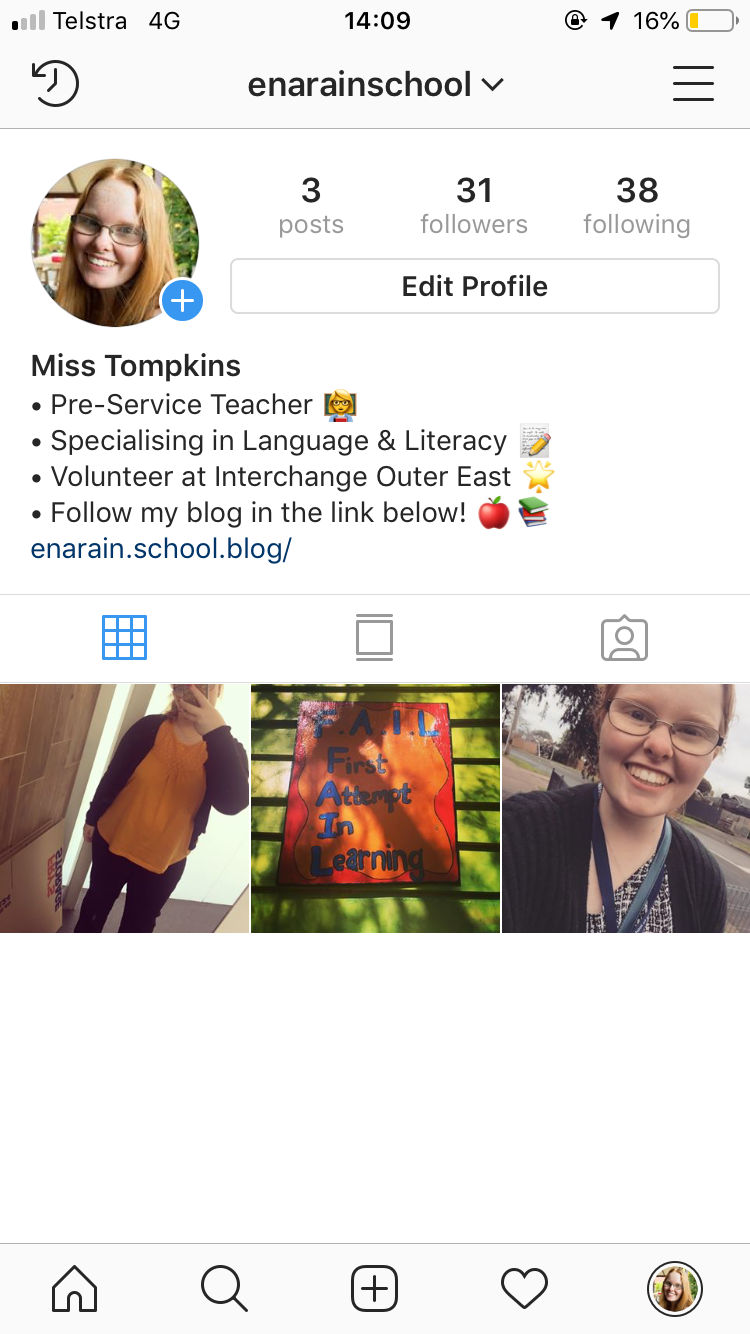
Smith & Watson suggest that ‘In online self-presentation as in offline life narration, the “I” of reference is constructed and situated, and not identical with its flesh-and-blood maker’ (2014, p.71). Further, online users construct their online profiles as what they believe as ‘revealing their “real” or “true” essence, a person or “me” who is unique singular, and outside social constructions and constraints’ (Smith & Watson 2014, p.71). Below is my summative response to the concept of online self-presentation.
I like to think that no matter which profile I’m creating from; personal, musical or educational, that I am conveying a true person that is passionate about whatever they are putting onto any platform used. As a pre-service teacher, I cannot share much expertise, however, I can track my progress in the course as a life-learner and be inspired by others in the same profession online. This may be what is meant by the term, “digital storytelling”, which is referred to by Smith & Watson as the ‘transmission of personal stories in digital forms’ (Smith & Watson 2014, p.71-72). Further they credit Nick Couldry for stating that “the whole range of personal stories now being told in potentially public form using digital media resources” (Couldry 2008, p.347),’ (Smith & Watson 2014, p.71-72).By participating in digital storytelling, online users can make connections, which create networks that can teach and inspire others.
Gauntlett comments on the progress of the internet by referring to the term ‘web 1.0’ compared with ‘web 2.0’. ‘Web 1.0’ refers to people being able to visit each other’s websites but otherwise websites were always kept separate. Whereas ‘web 2.0’ is labelled as a ‘collective allotment’, as people tend to work together and create content on a shared platform rather than choosing to only work on their own sites. Further Gauntlett discusses the power of the web through creation in three ways; connecting together to make something new, creativity involving a social dimension to allow connection with others and to make and share content to increase engagement (Gauntlett 2011, p.196). Personally, I make connections and networks online by following people who may follow me back on public profiles who share common interests and their posts come into my feed on these accounts and I ‘like’ them and sometimes leave comments or have conversations with followers.Web 2.0 has not only provided connection and networks but for some it provides freedom, such as for the women of Saudi Arabia according to Guta & Karolak. They credit this freedom to the ‘…blossoming of the new communication technologies may offer further opportunities for changes to women realities in such societies’ (2015, p.115).
Further, statistics depict that ‘50% of Saudi blog are written by women…female bloggers in Saudi Arabia are young, aged on the average between 18-30 years old, and educated (de Vriese, 2012)’ (Guta & Karolak 2015, p.16). Therefore, for these otherwise oppressed young women, the blogging world offers them opportunities to be influencers and connect with other women. They are able to ‘…forge completely new online identities, which can be multiple, or to reshape their offline identity…’ (Guta & Karolak 2015, p.118).
In conclusion, there is a strong connection between a person’s online persona and the connections they make. Further, teachers are beginning to recognise the many benefits of making and connecting and thus I begin to establish more of an online persona that creates meaningful content and connect with other students and professionals in the field.
Word count approx.: 758 words
References
Gauntlett, D 2011, Making is Connecting: The Social Meaning of Creativity from DIY and Knitting to Youtube and Web 2.0, Polity, Cambridge.
Guta, H & Karolak, M 2015, ‘Veiling and Blogging: Social Media as Sites of Identity Negotiation and Expression among Saudi Women’, Journal of International Women’s Studies, vol 16, issue 2, p. 115-116, 118.
Smith, S & Watson, J 2014, Identity Technologies: Constructing the Self Online, University of Wisconsin Press, retrieved: 15 April 2019.
 Enara Goes To School